Showing posts with label Research. Show all posts

Monday, 23 June 2014

Sense of touch.

Touch is key

For people with hearing and sight impairment, touch can be important.
It helps with communication – many deafblind people use a form of sign language involving touch called hand-on-hand signing, or they may use their fingers to read Braille.
It helps with connecting – feeling the touch of their friends and loved ones becomes significant when you can’t see or hear.
It helps with learning – especially important for babies and children with sight and hearing problems.


Tuesday, 20 May 2014

Illusion.

I started looking into illusions for my new idea for my FMP. Heather showed me this piece of art which really interested me. It involves mirrors and illusion to make the viewer think they are seeing a ghost but really they are just seeing a reflection.

http://en.wikipedia.org/wiki/Pepper's_ghost


For Amy.

http://www.lovelyish.com/2012/02/15/classical-painted-ladies-get-the-airbrush-treatment/

Tuesday, 13 May 2014

Fear survey.

I found a fear survey online and I actually found it quite helpful because of all the different questions that were asked which will help me with my FMP work.

How old are you?


What insect are you most afraid of?


What animal are you most afraid of?


What crime are you most afraid of?


What form of transportation are you afraid of?


What health issue are you most afraid of?


What supernatural being are you afraid of?


What is it about fire that scares you most?
  • 10 of you said the heat.
  • 24 of you fear losing your belongings.
  • 22 of you fear injury to yourself.
  • 99 of you fear injury to family/friends.
  • 24 of you fear injury to pets.
  • 9 of you fear smoke inhalation.
  • 145 of you fear being trapped in the fire.
  • 33 of you fear not having a house if your house catches fire.
  • 44 of you are not scared of fire at all.

  • What do you fear most about water?
  • 172 of you fear sharks the most.
  • 1 of you fears whales the most.
  • 13 of you fear stingrays the most.
  • 8 of you fear eels the most.
  • 2 of you fear fish the most.
  • 11 of you fear seaweed the most.
  • 1 of you fears crabs the most.
  • 20 of you fear alligators the most.
  • 31 of you fear jellyfish the most.
  • 2 of you fear sea turtles the most.
  • 97 of you fear deep water the most.
  • 53 of you aren't scared of water.

  • What aspect of your house scares you the most?
  • 39 of you fear your basement the most.
  • 12 of you fear a closet.
  • 5 of you fear the area under your bed (we bet your parents do too!)
  • 124 of you fear strange noises.
  • 10 of you fear the furnace.
  • 18 of you fear the garage.
  • 19 of you fear spooky shadows.
  • 56 of you fear possible ghosts.
  • 130 of you are not scared by your house.

  • What's your biggest fear about your family?


    What do you fear most about school?
  • 18 of you fear reading out loud.
  • 10 of you fear taking tests.
  • 50 of you fear public speaking.
  • 14 of you fear not knowing the answer to a question when the teacher calls on you.
  • 10 of you fear report cards.
  • 9 of you fear bullies.
  • 55 of you fear getting bad grades.
  • 7 of you fear going to a new school.
  • 10 of you fear peer pressure.
  • 20 of you fear gossip.
  • 27 of you fear being made fun of.
  • 17 of you fear not having anyone to sit with at lunch.
  • 24 of you fear not fitting in.
  • 7 of you fear disapproval from your teacher.
  • 9 of you fear gym class.
  • 2 of you fear riding the bus to school.
  • 13 of you fear bomb threats.
  • 56 of you fear school shootings.
  • 51 of you do not fear anything about school.

  • What do you fear most about going to the doctors?


    What is your most common fear?


    Fear/Anxeity.

    This is a chemical called 'cortisol' which is a chemical that is continually secreted throughout the day by the adrenal glands. These are triangular-shaped, and they sit on top of the kidneys. Cortisol secretion follows a 24 hour, or circadian rhythm, with peak levels occurring in the morning (from about 6.00am-8.00 am) and the lowest levels are at about midnight. There are many factors that influence cortisol levels including fasting, exercise, and anxiety.

    Fear of illness/death. (Damien Hurst)

    Most people are afraid of dying and I'm pretty sure everyone is afraid of cancer. However, I was looking at some of Damien Hurst's art and found some really interesting installations about smoking and a piece showing lung cancer which I found really pretty.

    http://www.damienhirst.com/second-series-biopsy-m132244

    http://www.damienhirst.com/artworks/catalogue?p=2&radiogroup_view=view_as_thumbs&category=18

    http://www.damienhirst.com/artworks/catalogue?p=2&radiogroup_view=view_as_thumbs&category=50

    http://www.damienhirst.com/the-dead-ones

    The ashtrays and the biopsy painting are my favourite but I also really like the cigarette cabinets because it is scary to see how many cigarettes people smoke then the cancer biopsy shows what it can do to you which I find really scary yet beautiful at the same time.

    http://www.damienhirst.com/trinity--pharmacology-physio

    I have also been looking into anatomy because I find it really interesting and scary to see how the body works and knowing that all that stuff is happening right now inside us without us knowing it's happening.

    Ideas for FMP.

    http://chemistry.about.com/od/halloweenchemistry/a/Fake-Flesh-Recipe.htm

    http://grist.org/list/heres-the-fake-human-flesh-bread-to-complete-your-fake-human-flesh-sandwich/

    http://www.huffingtonpost.com/2012/06/07/bread-human-body-parts_n_1577787.html#slide=1067117

    http://www.amusingplanet.com/2012/06/kittiwat-unarrom-creates-gruesome-human.html

    Thursday, 8 May 2014

    1990s Installation Art.


    Body cast artist.


    For my FMP I looked up Antony Gormley to see how he does his body casts. I want to use this for my final piece where I would cast a body and use it as a installation to create a sense of fear.


    Wednesday, 7 May 2014

    Artist inspiration.

    Kiki Smith Lilith - 1994


    "In medieval Jewish lore, Lilith was Adam’s first wife. When she demanded to be Adam’s equal, she was evicted from the Garden of Eden. Lilith flew away to the demon world, replaced by the more submissive Eve. Smith catches us off guard with Lilith’s pose and placement. Most sculptures receive our gaze passively, but Lilith stares back with piercing brown eyes, ready to pounce."

    I really like this piece, I want to do something like this in my own work because the black figure and the piercing glare gives a sense of fear. If I could use something like this in my art to create the same feeling I would be very happy.

    Wednesday, 30 April 2014

    Fear and Phobias.

    What is fear?


    Fear is one of the most basic human emotions. It is programmed into the nervous system and works like an instinct. From the time we're infants, we are equipped with the survival instincts necessary to respond with fear when we sense danger or feel unsafe.
    Fear helps protect us. It makes us alert to danger and prepares us to deal with it. Feeling afraid is very natural — and helpful — in some situations. Fear can be like a warning, a signal that cautions us to be careful.
    Like all emotions, fear can be mild, medium, or intense, depending on the situation and the person. A feeing of fear can be brief or it can last longer.


    How fear works.


    When we sense danger, the brain reacts instantly, sending signals that activate the nervous system. This causes physical responses, such as a faster heartbeat, rapid breathing, and an increase in blood pressure. Blood pumps to muscle groups to prepare the body for physical action (such as running or fighting). Skin sweats to keep the body cool. Some people might notice sensations in the stomach, head, chest, legs, or hands. These physical sensations of fear can be mild or strong.
    This response is known as "fight or flight" because that is exactly what the body is preparing itself to do: fight off the danger or run fast to get away. The body stays in this state of fight-flight until the brain receives an "all clear" message and turns off the response.
    Sometimes fear is triggered by something that is startling or unexpected (like a loud noise), even if it's not actually dangerous. That's because the fear reaction is activated instantly — a few seconds faster than the thinking part of the brain can process or evaluate what's happening. As soon as the brain gets enough information to realize there's no danger, it turns off the fear reaction. All this can happen in seconds.


    Fears People Have

    Fear is the word we use to describe our emotional reaction to something that seems dangerous. But the word "fear" is used in another way, too: to name something a person often feels afraid of.
    People fear things or situations that make them feel unsafe or unsure. For instance, someone who isn't a strong swimmer might have a fear of deep water. In this case, the fear is helpful because it cautions the person to stay safe. Someone could overcome this fear by learning how to swim safely.
    A fear can be healthy if it cautions a person to stay safe around something that could be dangerous. But sometimes a fear is unnecessary and causes more caution than the situation calls for.
    Many people have a fear of public speaking. Whether it's giving a report in class, speaking at an assembly, or reciting lines in the school play, speaking in front of others is one of the most common fears people have.
    People tend to avoid the situations or things they fear. But this doesn't help them overcome fear — in fact, it can be the reverse. Avoiding something scary reinforces a fear and keeps it strong.
    People can overcome unnecessary fears by giving themselves the chance to learn about and gradually get used to the thing or situation they're afraid of. For example, people who fly despite a fear of flying can become used to unfamiliar sensations like take off or turbulence. They learn what to expect and have a chance to watch what others do to relax and enjoy the flight. Gradually (and safely) facing fear helps someone overcome it.


    Phobias

    A phobia is an intense fear reaction to a particular thing or a situation. With a phobia, the fear is out of proportion to the potential danger. But to the person with the phobia, the danger feels real because the fear is so very strong.
    Phobias cause people to worry about, dread, feel upset by, and avoid the things or situations they fear because the physical sensations of fear can be so intense. So having a phobia can interfere with normal activities. A person with a phobia of dogs might feel afraid to walk to school in case he or she sees a dog on the way. Someone with an elevator phobia might avoid a field trip if it involves going on an elevator.
    A girl with a phobia of thunderstorms might be afraid to go to school if the weather forecast predicts a storm. She might feel terrible distress and fear when the sky turns cloudy. A guy with social phobia experiences intense fear of public speaking or interacting, and may be afraid to answer questions in class, give a report, or speak to classmates in the lunchroom.
    It can be exhausting and upsetting to feel the intense fear that goes with having a phobia. It can be disappointing to miss out on opportunities because fear is holding you back. And it can be confusing and embarrassing to feel afraid of things that others seem to have no problem with.
    Sometimes, people get teased about their fears. Even if the person doing the teasing doesn't mean to be unkind and unfair, teasing only makes the situation worse.


    What Causes Phobias?

    Some phobias develop when someone has a scary experience with a particular thing or situation. A tiny brain structure called the amygdala keeps track of experiences that trigger strong emotions. Once a certain thing or situation triggers a strong fear reaction, the amygdala warns the person by triggering a fear reaction every time he or she encounters (or even thinks about) that thing or situation.
    Someone might develop a bee phobia after being stung during a particularly scary situation. For that person, looking at a photograph of a bee, seeing a bee from a distance, or even walking near flowers where there could be a bee can all trigger the phobia.
    Sometimes, though, there may be no single event that causes a particular phobia. Some people may be more sensitive to fears because of personality traits they are born with, certain genes they've inherited, or situations they've experienced. People who have had strong childhood fears or anxiety may be more likely to have one or more phobias.
    Having a phobia isn't a sign of weakness or immaturity. It's a response the brain has learned in an attempt to protect the person. It's as if the brain's alert system triggers a false alarm, generating intense fear that is out of proportion to the situation. Because the fear signal is so intense, the person is convinced the danger is greater than it actually is.


    Thursday, 24 April 2014

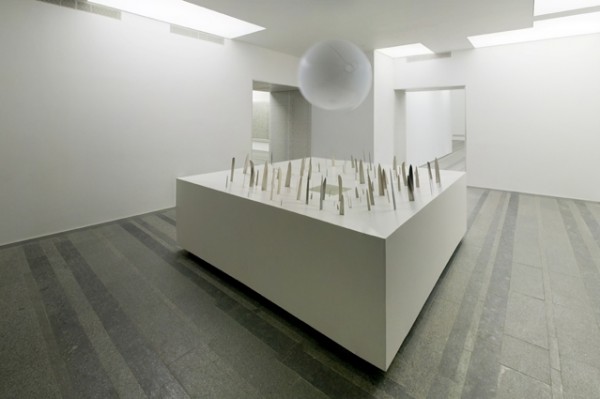
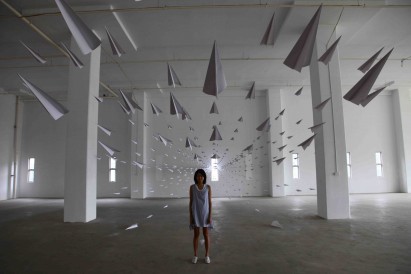
    More installation art

    I really like this piece. It gave me an idea to get some clear balloons and fill them with 'blood' and hang them in a similar way to this. I think that would look quite interesting.
     

    Tim Burton

    I looked at Tim Burton's exhibition and found some creepy pieces of art that I think will really help me with my work and influence parts of it.

    I think this piece is quite interesting and scary in a way,
    I might try something like this in my work but not as 'surreal' as Tim Burton.


    I really like this piece. I like how they use light to create a creepy
    feeling because we use light as a child to not be scared of the dark
    but they have used it the completely opposite way.
    

    Installation art


    The end of this video shows Damien Hirst's 'A History of Pain'
     
     
    I really like all these pieces of work and I think they will influence my work quite a lot.

    Tuesday, 22 April 2014

    CD bubble


    Final Major project

    I want to continue exploring fear and phobias for my final major project. I decided to look at doll houses because one of my ideas was to create a small doll house thing for people to look into.


    I then looked at a piece by Tim Burton from the Tim Burton museum. I thought it looked quite creepy so I decided to use it as inspiration for my work.


    Thursday, 20 March 2014

    Fake cake icing

    How to make fake cake icing:


    Specialist field: Prop and Costume

    Prop research:
    A prop is a short word for property that is used by actors during a performance or screen production. A prop is anything movable or portable on a stage or set.


    Set designers for Alice in Wonderland:


    Lauren Daspit


    These are the model makers that were involved in Alice in Wonderland (1999)
    Model Makers: Jamie Courtier, Adrian Parish, Dan Burnett, Nicky Lions, Mark Hunter, Nigel Blake, and Simon Williams

    Adrian Parish was a anamatronic designer for Alice in Wonderland and Jamie Courtier was a model maker.

    Jim Henson created the hedgehog from the Tim Burton Alice in Wonderland:


    Thursday, 13 March 2014

    Fake cake research

    Fake cakes made from sponge


    Fake chocolates


    Fakes cakes


    Fake buiscuits


    Clay cake


    Fake lollipops made from clay


    Thursday, 6 March 2014